

by Thomas Moser
Isaac Newton, the founder of modern physics, spent nearly as much of his career as a money manufacturer as he did as a professor at the University of Cambridge. Newton was appointed professor of mathematics at Cambridge in 1669, but moved to London in 1696 to assume the role of warden of the Royal Mint, then housed in the Tower of London. Three years later, he was promoted to Master of the Mint, a position he held until his death in 1727.
During his tenure, Newton oversaw the “Great Recoinage” of England’s currency. An issue that particularly drew his attention was counterfeiting. He estimated that as many as 20% of the coins collected during the recoinage were counterfeit. In response, he devoted considerable effort to combating forgery and improving the quality and security of coin production.
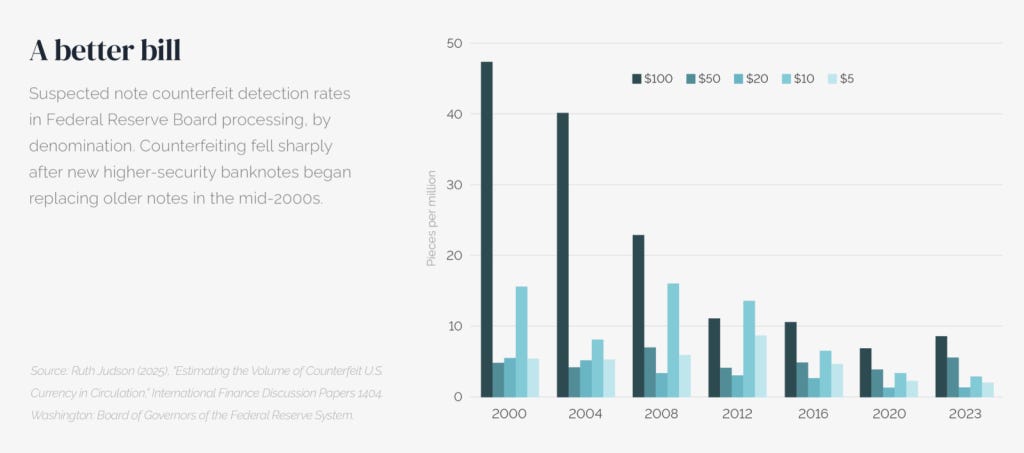
Newton would likely be impressed by the success of modern anti-counterfeiting measures. According to the Bank of England, only 0.0025% of banknotes were found to be counterfeit in 2023, and the figure is even lower in the Eurozone, at just 0.0016%. For the US dollar, the most recent publicly available report from 2006 estimated the counterfeit rate at 0.01% — though more recent figures suggest it may now be closer to 0.0025%.
Money as matter
Money, like language, was not invented. In explaining the origin of money back in 1892, the economist Carl Menger showed that it could emerge spontaneously as individuals sought to overcome the inefficiencies of barter. Over time, people would naturally begin to favor a particular commodity as a medium of exchange — one that possessed certain qualities, such as durability and divisibility, that made it more widely desirable.
Historically, many different commodities have served as money, including cattle, animal skins, salt slabs and cowrie shells. However, precious metals eventually proved especially well-suited for this role due to their divisibility and malleability. From this realization, it was one more logical step — at least in hindsight — toward the invention of coinage. Coined money was invented between 900 and 600 BCE in three distinct regions: China, Greece (and Asia Minor), and India.
The minting of physical money, originally in the form of coins and later including banknotes, brought a new level of standardization to the monetary system, facilitating transactions. But in addition to standardization, minting also ensured that coins and bills are recognized and trusted across the economy. To sustain this trust, however, it became essential to produce money in a way that made
its authenticity easy to verify, while also making counterfeiting difficult.
Counterfeit money poses an obvious problem for individuals or businesses that unknowingly receive it, as they bear the full financial loss if it cannot be passed on. And the issue extends beyond individual losses. First, money depends on public confidence; when people begin to suspect that the money they receive might be fake, it undermines trust in the currency and can reduce its acceptance in everyday transactions. Second, even if counterfeit money circulates undetected, society bears a cost: The revenue from money creation accrues to counterfeiters rather than the state. Moreover, an increase in the overall money supply from counterfeit money can contribute to inflation, eroding the purchasing power of money for everyone.
Taxpayers also shoulder the burden in less direct ways. Law enforcement agencies must allocate resources to investigating and preventing counterfeiting, while governments and central banks continually invest in developing more secure forms of money to stay ahead of counterfeiters. For example, the Swiss franc banknotes used in Switzerland and Liechtenstein are widely considered the most secure in the world, thanks to their extensive array of advanced security features. This high level of protection, however, also makes them among the most expensive banknotes to produce.
Money as information
Newton would likely have been astonished by the developments in both physics and money since his time. In the early 20th century, it became increasingly clear that Newtonian physics could not adequately explain phenomena at the atomic and subatomic levels. This led to the emergence of quantum mechanics. Unlike classical physics, quantum mechanics revealed that particles do not possess precise positions and velocities but instead exist in probabilistic states. This deeper understanding of electron behavior at the quantum level directly enabled the invention of the transistor and the rise of semiconductor electronics, forming the foundation of modern computing.
The dematerialization of money began long before the digital age. Even in early banking systems, money increasingly came to be represented as entries in ledgers rather than as physical coins or notes. However, the transition accelerated in the 1960s with the advent of modern computing and database technologies. Since then, money has shifted from physical and analog forms to predominantly digital ones. Today, the vast majority of money exists electronically in bank accounts, payment cards or digital wallets, recorded as digits in computer systems.
As money lost its physical form, it also ceased to function as a bearer instrument: an object whose mere possession conferred ownership. In a ledger-based system, ownership must be recorded, and transactions are processed by updating the ledger. This shift makes preserving privacy difficult — as all transactions are, by design, linked to records. The same is true of cryptocurrencies like Bitcoin, which are also ledger-based. The key difference is that cryptocurrency ledgers are not centralized, but distributed across a network. In both cases, the act of transferring money amounts to exchanging messages —
information about changes in the ledger — rather than handing over a physical object. One major advantage of this approach is the ability to conduct transactions remotely.
However, this digitalization introduces new vulnerabilities. Because digital information can be intercepted or perfectly copied, digital money must be safeguarded against counterfeiting and tampering through advanced security measures. Ensuring authenticity and integrity in a digital environment requires sophisticated cryptographic techniques, along with secure, tamper-resistant systems for record-keeping and communication.
The end of the digital age
While today’s digital money is a product of the first quantum revolution of the early 20th century, it is the second quantum revolution of the late 20th century that poses its greatest challenge. This second revolution involves a deeper harnessing of quantum phenomena in ways that go far beyond the initial revolution’s focus on understanding and utilizing individual quantum particles.
Modern computing — including the storage, transmission, and processing of information — is based on classical information theory, which follows the laws of classical physics. Its fundamental unit of information is the binary digit, better known as the bit, which can represent one of two possible states: 0 or 1. Systems that require more than two outcomes simply combine more bits to represent the
full range. All information, then, can be encoded as sequences of 0s and 1s. However, as physicist Richard Feynman memorably declared in a 1981 lecture often credited with launching the field of quantum computing: “Nature isn’t classical, dammit, and if you want to make a simulation of nature, you’d better make it quantum mechanical.”
‘This is thrilling news for science and technology, but troubling for classical cryptography and, by extension, digital money.’
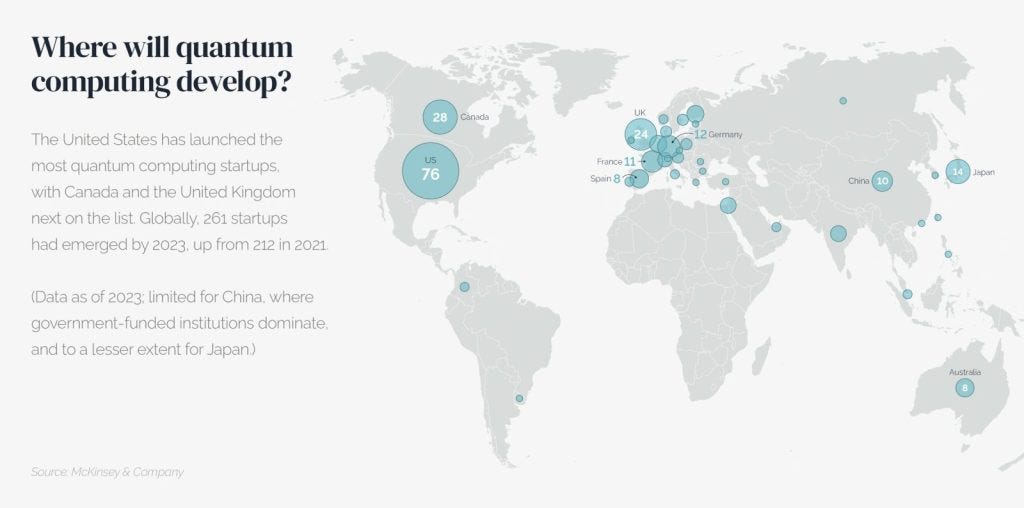
Quantum computing becomes possible through two of the most counterintuitive principles of quantum mechanics, principles that even Einstein struggled with: superposition and entanglement. A quantum system (such as a subatomic particle or photon) can exist in a superposition of multiple states simultaneously. This means that while a classical bit can represent either 0 or 1, a qubit (quantum bit) can exist in a state that is both 0 and 1, with certain probabilities. This allows quantum systems to carry and process far more information than classical bits.
Moreover, when particles are entangled, their quantum states become linked in such a way that the state of one particle instantly affects the state of the other, regardless of distance. For quantum computing, this means qubits — even when physically separated — can still interact with each other. Together, superposition and entanglement create a completely new type of computing system: not simply a more powerful computer, but a fundamentally different one capable of solving problems that classical computers never could.
This is thrilling news for science and technology, but troubling for classical cryptography and, by extension, digital money. Most modern cryptographic systems, such as those securing online banking and cryptocurrencies, rely on the assumption that certain mathematical problems — like factoring large integers or solving discrete logarithms — are computationally infeasible to solve in a reasonable amount of time, even when using very powerful classical computers. But for quantum computers, several of these ”hard” problems become tractable.
To address this emerging threat, researchers have developed post-quantum cryptography (also called quantum-resistant or quantum-safe cryptography). In August 2024, the US National Institute of Standards and Technology (NIST) released the first official post-quantum cryptographic standards, urging computer system administrators to begin transitioning to these new protocols as soon as possible. However, it is important to note that post-quantum cryptography is not fundamentally different from classic cryptography. It merely substitutes a new set of mathematical problems believed to be hard for quantum computers for the types of problems that had been previously relied upon. What would represent a truly fundamental shift is quantum cryptography, which is rooted directly in the laws of quantum mechanics.
Money as communication
In the 1960s, while still a graduate student in physics at Columbia University, Stephen Wiesner proposed a groundbreaking idea: secure money based on the principles of quantum mechanics. His concept, known as quantum money, envisioned each bill being tied to a unique quantum state. The central innovation was that quantum money would be impossible to counterfeit, not just due to technological limits but because of the fundamental laws of quantum physics — entirely independent of any future advances in computing or mathematics.
Although the paper in which Wiesner explained his idea was rejected for publication — likely because it was so ahead of its time that editors and referees could not grasp its significance — it circulated among physicists interested in information theory. It would go on to have a profound impact on the development of quantum cryptography and quantum computing.
Wiesner recognized that classical money, such as coins and banknotes, is inherently vulnerable to forgery because it relies on reproducible physical representations. By contrast, quantum states are fundamentally unclonable. This property is laid out in the no-cloning theorem, which states that an unknown quantum state cannot be copied without altering it in a detectable way. Any attempt to duplicate quantum money would disturb its state, revealing the forgery attempt. In Wiesner’s original scheme, a piece of quantum money consists of two components: a serial number, and a quantum state associated
uniquely with that serial number.
The mint, or issuing bank, keeps a secure database mapping each serial number to its corresponding quantum state. When someone uses the quantum money to pay a merchant, the merchant sends the serial number and quantum state to the mint for verification. The mint retrieves the expected quantum state and checks whether the submitted state matches, thereby verifying the money’s authenticity.
The system thus involves two core procedures:
quantum-state generation process that issues the money, and
a verification process that evaluates a submitted quantum state and serial number pair, returning either “accept” or “reject.”
In practice, quantum money could be implemented using systems such as photon polarization or spin states in trapped ions, where each qubit encodes quantum information in a physical system. Because quantum measurement collapses the superposition of a quantum state, any verification inherently alters the state, making it tamper-evident. This “destructive measurement” property is a key reason quantum money cannot be counterfeited; once observed, it cannot be replicated.
Beyond its unique anti-counterfeiting properties, quantum money has several other remarkable features. Though inherently physical, since it consists of a quantum state, it can still be transmitted remotely and does not require a ledger. Instead, quantum money functions as a true bearer instrument — ownership is conferred by possession. This also opens the possibility for privacy-preserving transactions. While it is possible to design digital bearer instruments (as I explored in a 2021 working paper with David Chaum and Christian Grothoff), most digital currencies rely on distributed ledgers, which inherently involve identity and traceability.
Wiesner’s paper was eventually published in 1983, and since then, many researchers have sought to refine and extend his original scheme. One commonly cited limitation is that Wiesner’s quantum money can only be verified by the issuer. Merchants must contact the issuing authority to confirm a transaction, and the issuer must keep the state descriptions secret. This model has therefore become known as private-key quantum money.
Considerable effort has since been devoted to designing public-key quantum money — a system where anyone can verify the money’s authenticity without needing to contact the issuer. However, achieving this securely has proven much more challenging.
There have also been early experimental implementations of quantum money. These demonstrate that quantum states can indeed be encoded in physical systems, though doing so remains technologically demanding. Like quantum computing, however, the field is progressing steadily. Perhaps more importantly,
Wiesner’s core insight — that quantum mechanical properties can secure information in ways classical systems cannot — has laid the foundation for quantum key distribution (QKD), a widely implemented method that uses entanglement to enable unbreakable key exchange.
Newton the physicist might, like Einstein, have struggled with the strange principles of quantum mechanics. But Newton the master of the mint would no doubt have been delighted by the idea of a type of money that is inherently impossible to counterfeit.
The views expressed in this article are those of the author and do not necessarily reflect those of the Swiss National Bank.
This article was first published on the Duckbucks website.
Thomas Moser is an alternate member of the Governing Board of the Swiss National Bank and a visiting professor at the University of Lucerne. Before joining the Swiss National Bank, he was an executive director at the International Monetary Fund. He holds a master’s degree and a doctorate in economics from the University of Zurich.